BEMUFO See the modules Free 14-day trial Buy — $49
RM-DESIGNS RECOVERED CRAFT CONSOLE

System
BEMUFO

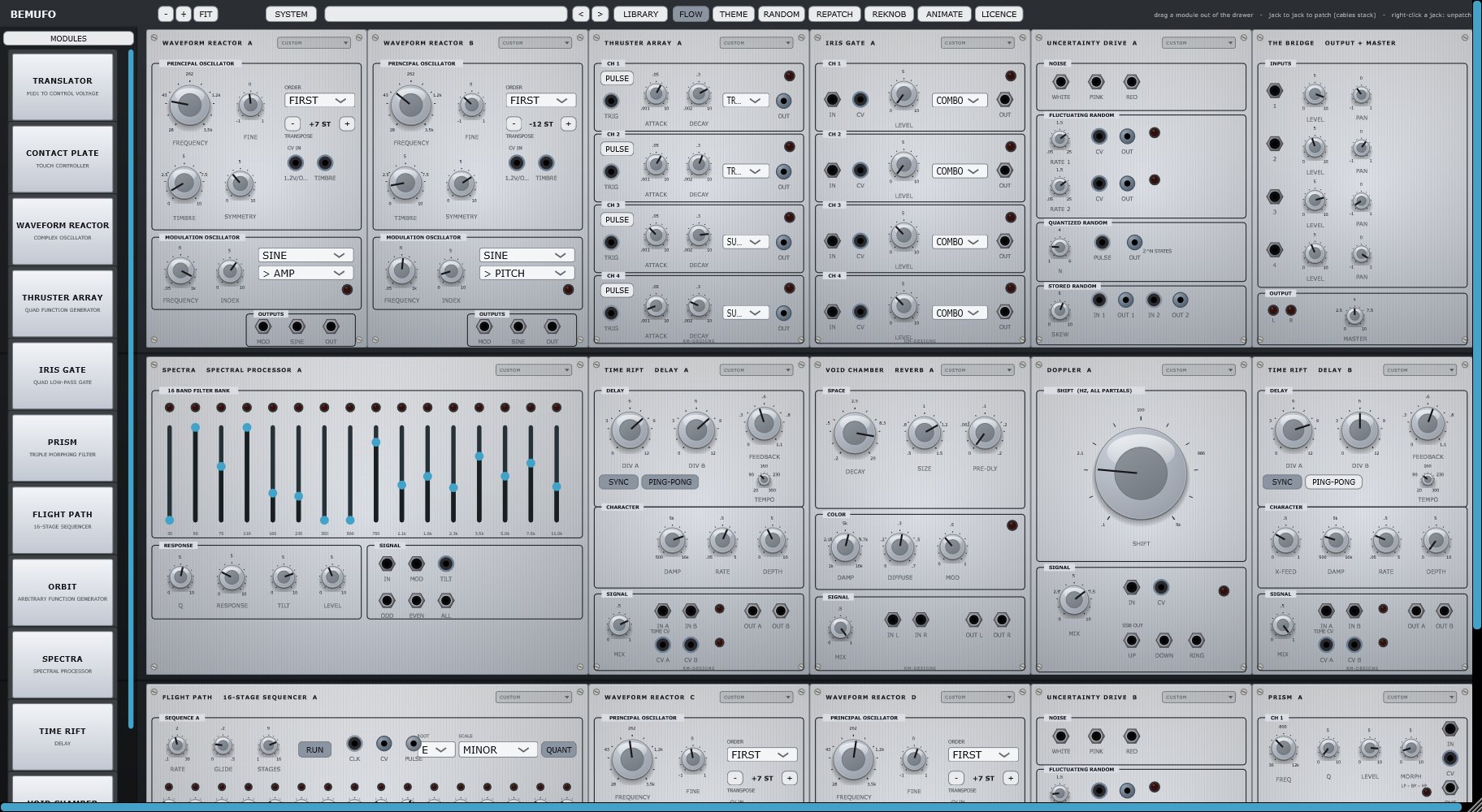
A complete exploratory modular system that runs standalone today, with the VST3 plugin next. Twenty-one module types, twenty-four panel spaces, and as many of each module as you can fit. Patch it with banana cables. Watch the voltage move through them.

14 days, every module unlocked, no account and nothing to sign up for. Keep it for $49.
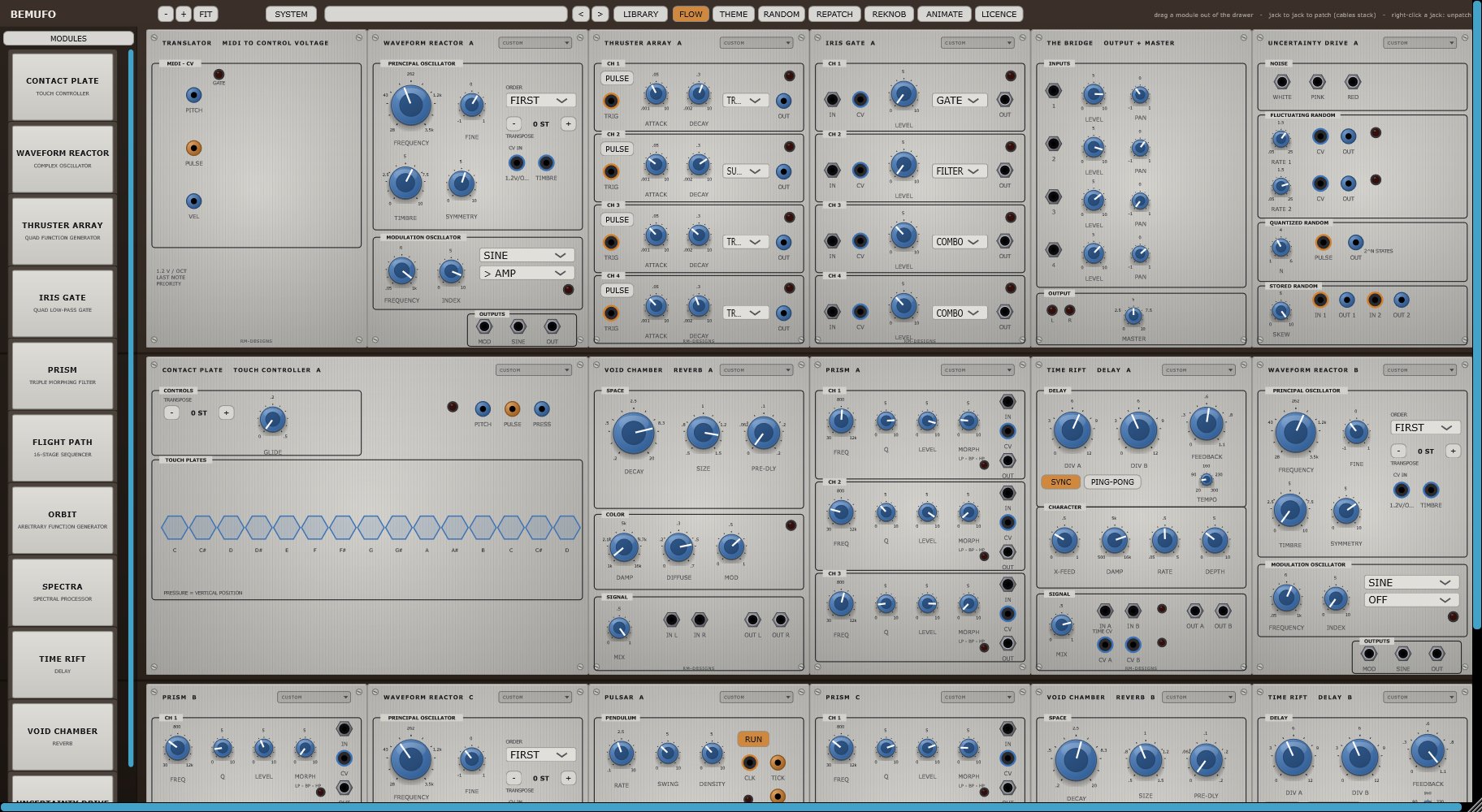
A twenty-four space BEMUFO, racked and patched Classic Silver
An 18-space system racked and patched by the RANDOM button. Pick any of the seventeen finishes.
Twenty-one modulesFolding oscillators, optocoupler-style gates, spectral processing, sequencers — rack as many of each as fit.
Patch it like hardwareBanana cables that stack, and a signal-flow view that shows the voltage actually moving.
$49, yours to keepOne payment, no subscription. Use it on up to three of your own computers. Fourteen days free before you decide.
21
Module types
24
Panel spaces
112
Factory patches
14
Day free trial

Not a synth. A system.

Rack it yourself

Drag modules from the shelf into any slot in the cabinet, from a four-space travel case up to a twenty-four-space studio system. Every type is unlimited — six oscillators and four filters is a normal afternoon. Modules stay exactly where you drop them; nothing snaps together.

Patch it yourself

Banana cables stack, so one output feeds as many inputs as you like. Control voltage and audio are separate patch domains, the way the hardware enforces it. Right-click a jack to pull the last cable off.

See the voltage

Switch on signal flow and the cables come alive: pulses travel as a bulge along the cord, control voltage breathes with the level, and audio cables take on the colour of the sound they carry — amber for bass, ice-blue as it brightens.

What makes it different

See the voltage

Switch on signal flow and the cords come alive: pulses travel as a bulge, control voltage breathes with level, and audio takes the colour of the sound it carries.

Randomize that works

It picks an idea, racks the modules that idea needs, and patches source into dynamics into output. Every result makes sound on its own.
Chrome

Seventeen panel finishes

Brushed aluminium, polished chrome, brass and copper, Aurora which drifts its hues, and five built for the craft it is. Patch cables get their own colourways on top. Every one is the real instrument, cycling here.

The module set

21 types · shown in the default finish
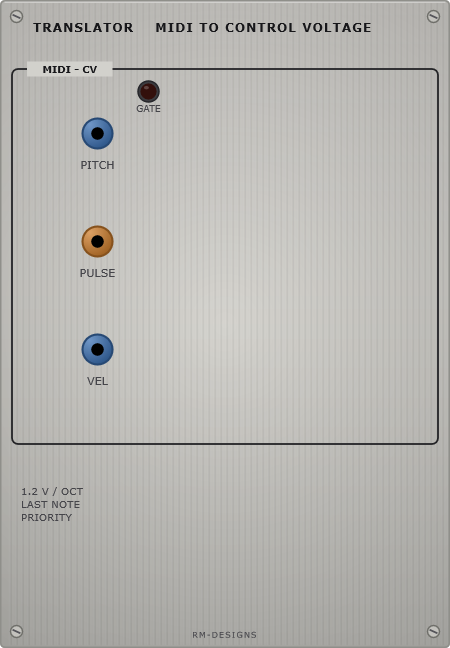
The Translator panel - midi to control voltage
TRANSLATOR
MIDI to control voltage
Turns your keyboard into control voltage: pitch at 1.2 volts per octave, a gate pulse, and velocity. Sub-block staccato still triggers cleanly.
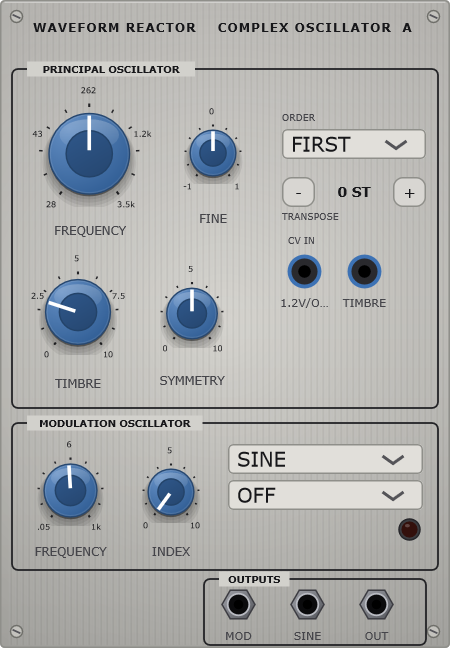
The Waveform Reactor panel - dual folding oscillator
WAVEFORM REACTOR
DUAL FOLDING oscillator
A principal oscillator folds its own sine into brass and bell timbres, with a second oscillator modulating pitch, timbre or amplitude.
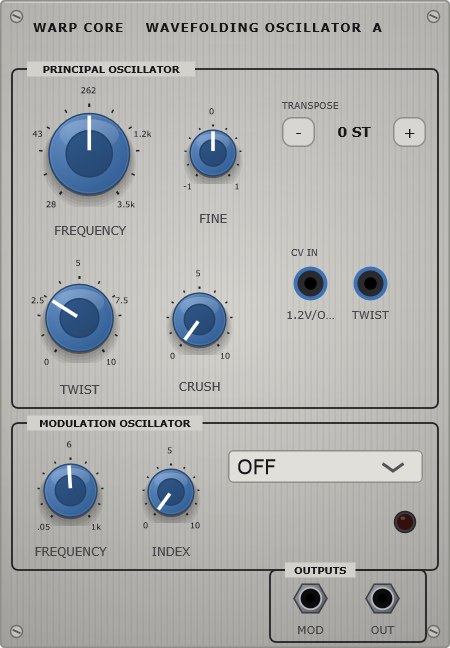
The Warp Core panel - wavefolding oscillator
WARP CORE
Wavefolding oscillator
Phase distortion and bit crushing, oversampled twice over so it grits without aliasing. Where the Waveform Reactor blooms, this one snarls.
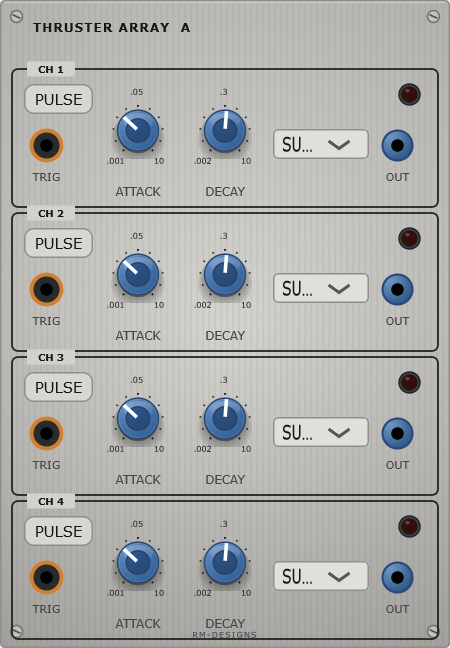
The Thruster Array panel - quad function generator
THRUSTER ARRAY
Quad function generator
Four independent envelopes. Each runs as a one-shot transient, a sustained shape that holds while gated, or free-running cyclic - which makes it an LFO without changing modules.
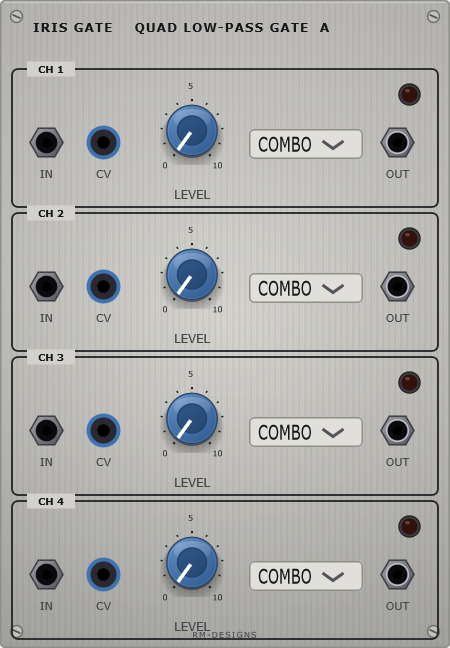
The Iris Gate panel - quad optocoupler-style gate
IRIS GATE
Quad optocoupler-style gate
Four optocoupler-inspired dynamics gates. Level and brightness fall together with a two-stage, level-dependent decay.
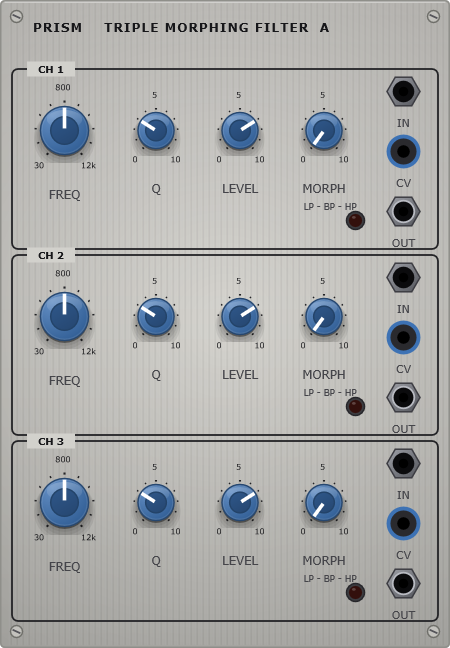
The Prism panel - triple morphing filter
PRISM
Triple morphing filter
Three channels that sweep continuously from low pass through band pass to high pass on one knob, each with its own CV input and resonance.
The Spectra panel - spectral processor
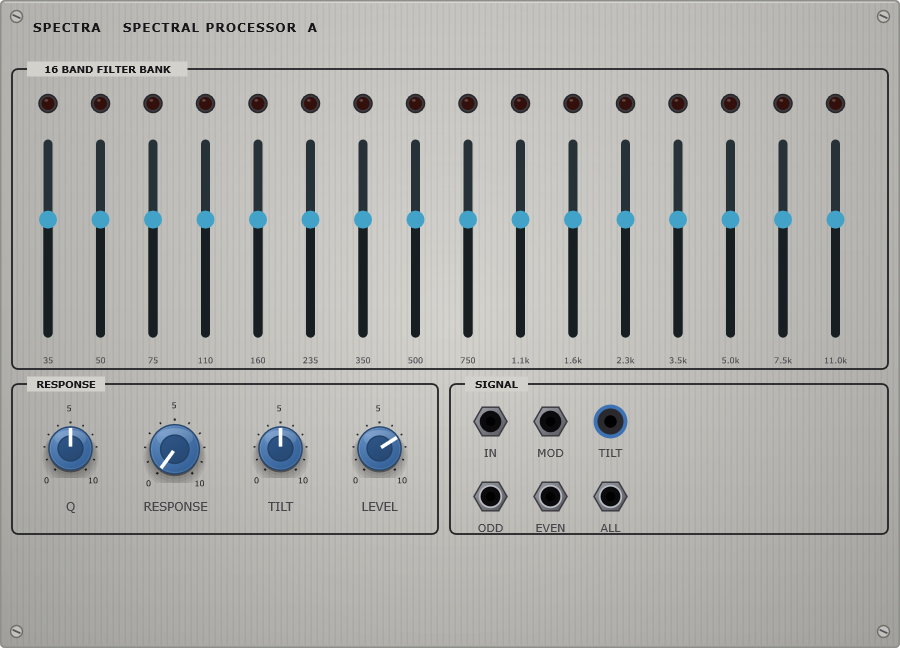
SPECTRA
Spectral processor
Sixteen bands with individual level control, odd, even and summed outputs, and an envelope follower - vocoding, formant shaping, or a filter bank you play by hand.
The Doppler panel - frequency shifter
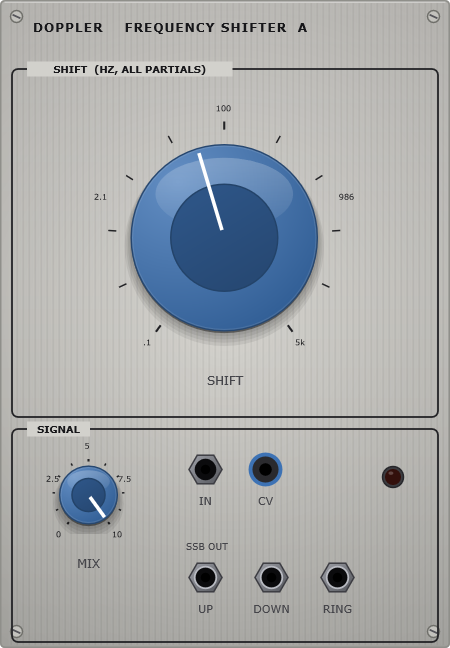
DOPPLER
Frequency shifter
True single-sideband shifting, not pitch shifting: everything moves by the same number of hertz, so harmonics land inharmonically. Up, down and ring outputs.
The Flight Path panel - 16-stage sequencer
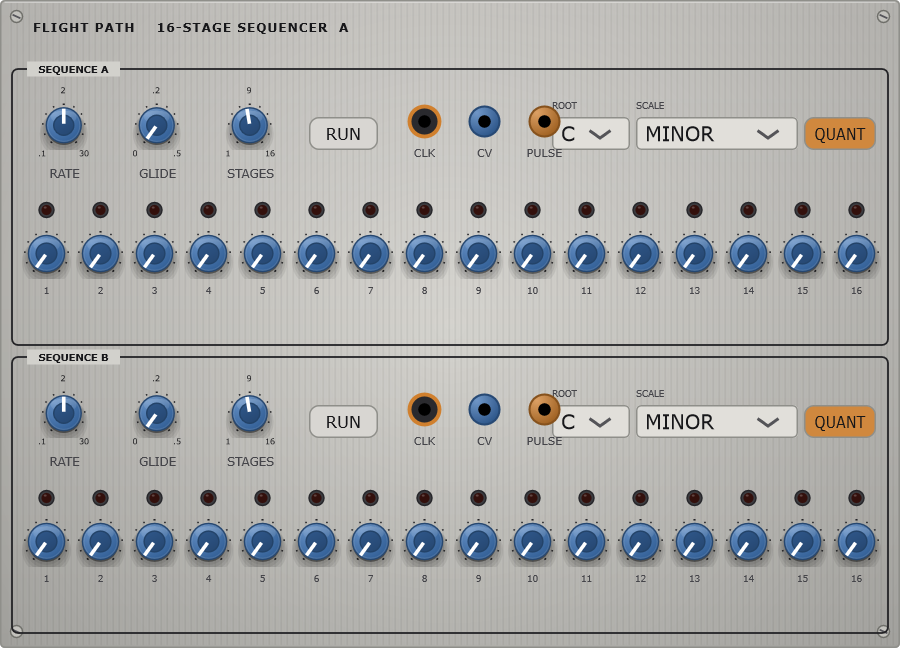
FLIGHT PATH
16-stage sequencer
Two sixteen-stage channels with independent clocks, sixteen scales and a root note, quantised or free. Run them at different lengths for polyrhythm.
The Orbit panel - arbitrary function generator
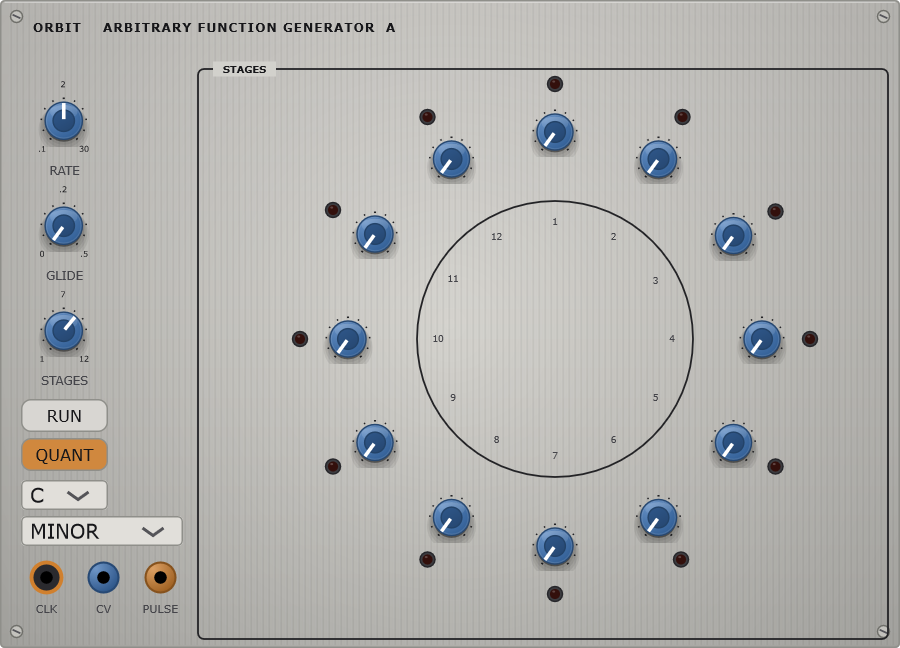
ORBIT
Arbitrary function generator
Twelve stages around a wheel with its own clock and glide - looser and more circular than a step sequencer.
The Pulsar panel - clock + ratchet
PULSAR
Clock + ratchet
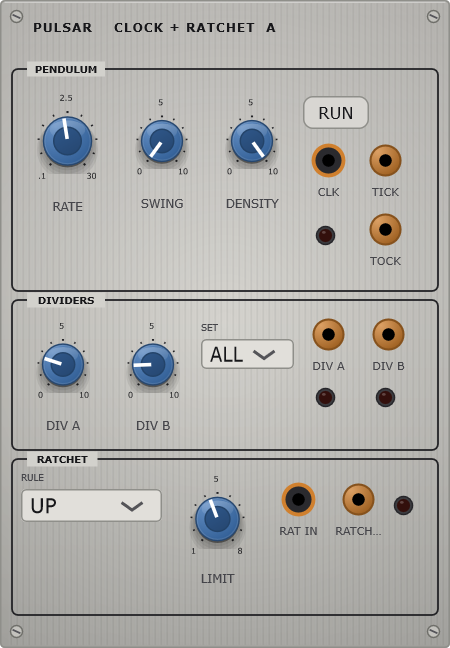
A swinging master clock with divider sets (odd, prime, Fibonacci, powers of two), ratchet bursts and a density-thinned output for patterns that breathe.
The Uncertainty Drive panel - noise + random voltages
UNCERTAINTY DRIVE
Noise + random voltages
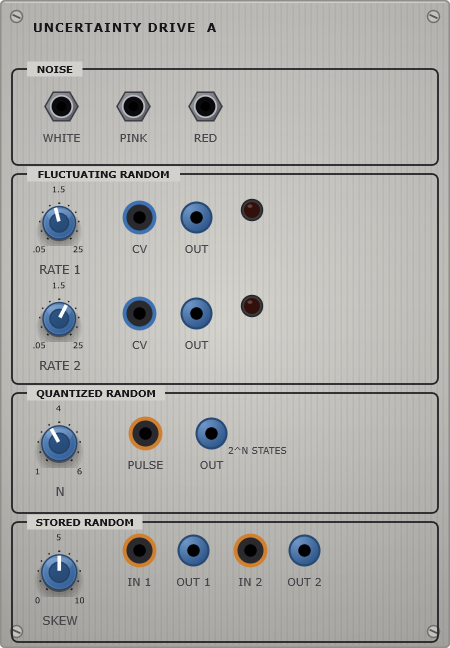
White, pink and red noise, two fluctuating random voltages and quantised random steps. The module that makes a patch never repeat itself.
The Contact Plate panel - touch controller
CONTACT PLATE
Touch controller
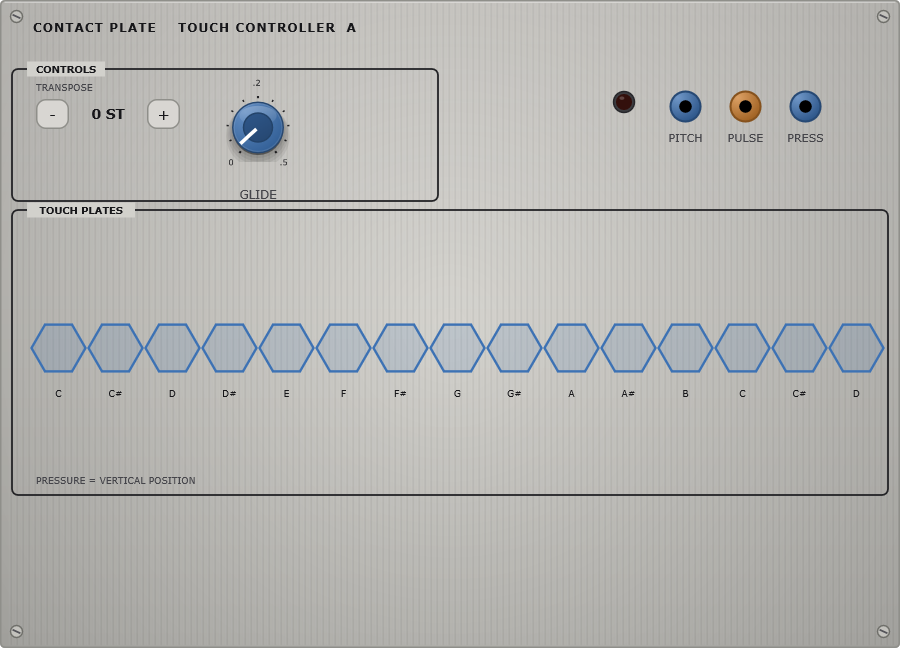
Capacitive touch plates that output pitch, a gate pulse and pressure - play it with your fingers instead of a keyboard.
The Memory Core panel - loop recorder
MEMORY CORE
Loop recorder
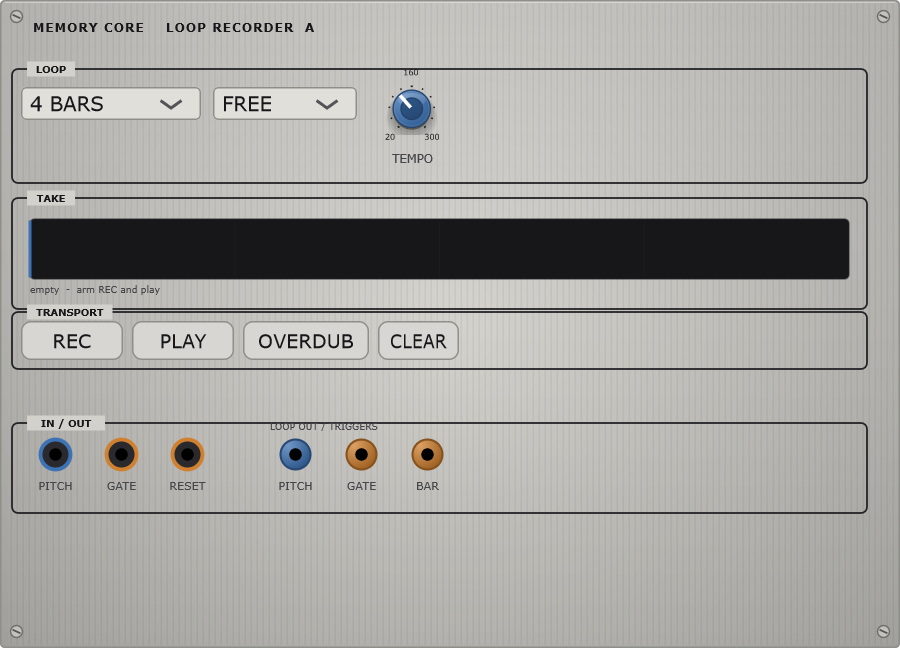
Records MIDI loops quantised to the bar and stores them inside the patch, so a saved file plays back exactly as you left it.
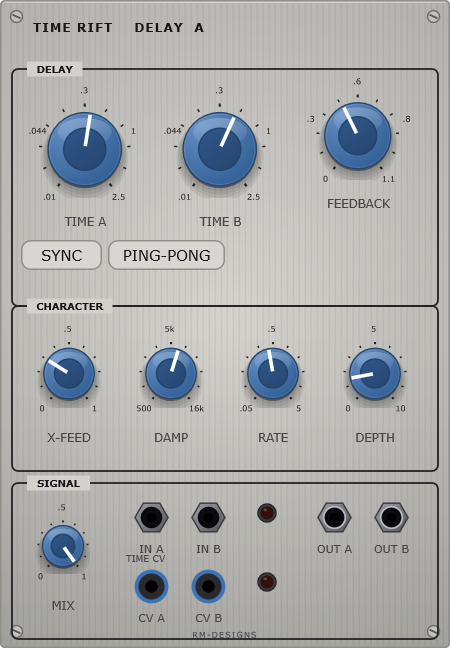
The Time Rift panel - delay
TIME RIFT
Delay
Dual delay that locks to your host tempo with snapping musical divisions, plus ping-pong panning, cross-feed and damping.
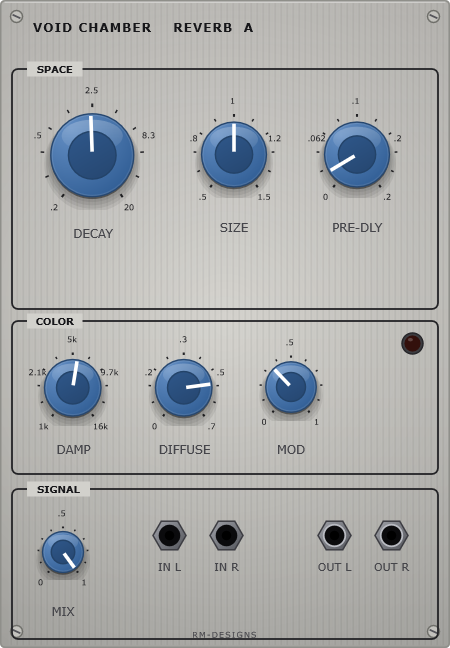
The Void Chamber panel - reverb
VOID CHAMBER
Reverb
An eight-line feedback reverb that goes from a tight room to twenty seconds of decay, with pre-delay, size, damping and diffusion.
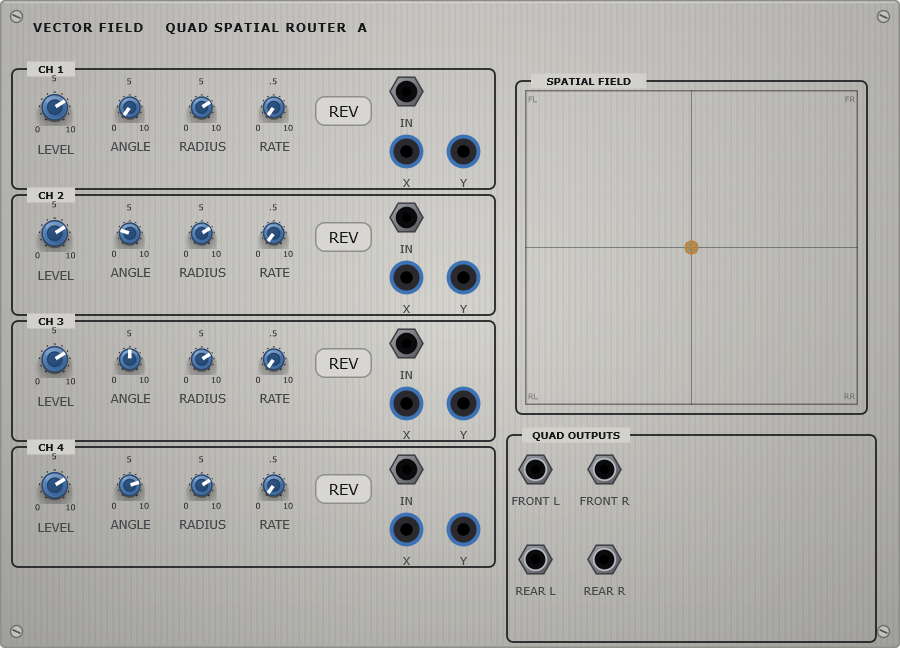
The Vector Field panel - quad spatial router
VECTOR FIELD
Quad spatial router
Four sources orbiting a two-dimensional field, distance-weighted across four outputs - motion rather than static panning.
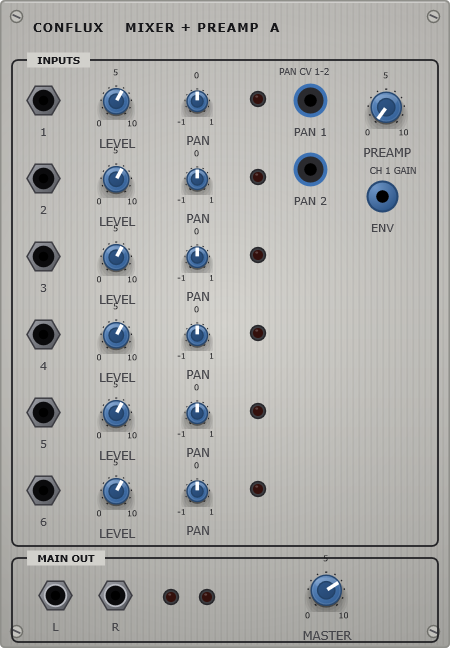
The Conflux panel - mixer + preamp
CONFLUX
Mixer + preamp
Six channels with panning and level, CV over the first two pans, and a preamp stage for driving the rest of the system harder.
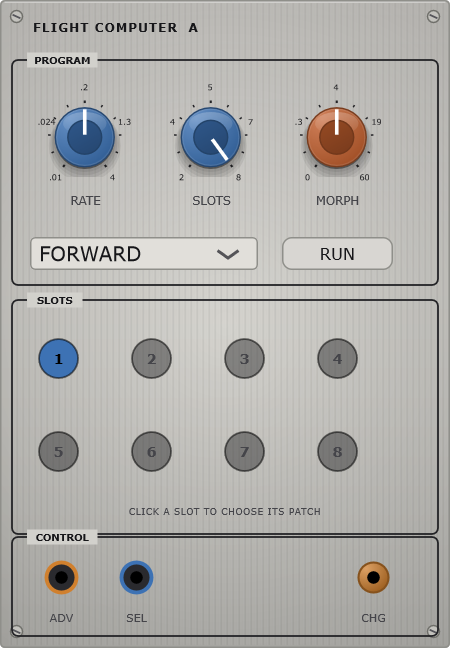
The Flight Computer panel - eight-slot preset computer
FLIGHT COMPUTER
8-slot preset computer
Eight slots holding factory presets or your own saved patches, stepped forward, ping-pong or at random - by its own clock, a patch cord, or a control voltage. Set a morph time and the instrument does not jump between them: every knob glides across, so one patch becomes the other while it plays.
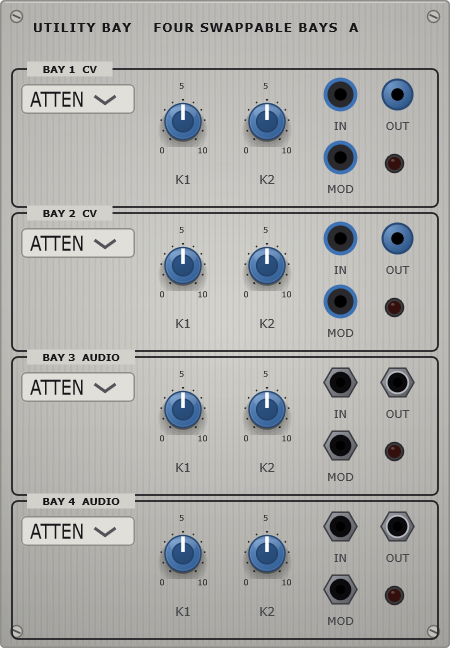
The Utility Bay panel - four swappable bays
UTILITY BAY
Four swappable bays
Four bays you assign: attenuator, slew limiter, AR envelope, VCA or LFO. The utility module that fills whatever gap a patch leaves.
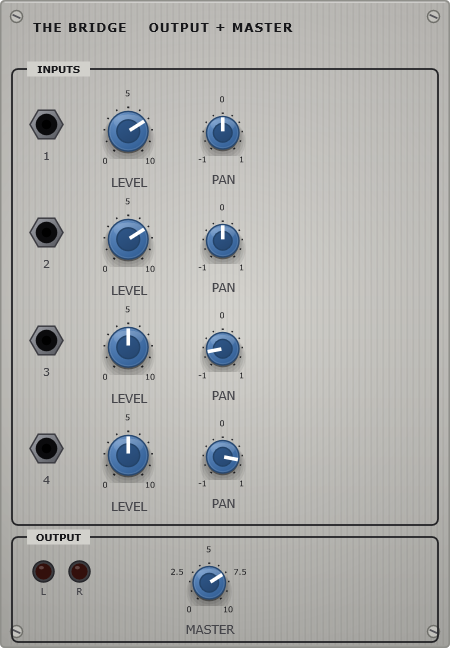
The The Bridge panel - output + master
THE BRIDGE
Output + master
Four inputs with absolute panning into the stereo bus, and the master output stage everything eventually arrives at.

Made to be played, not configured

112 patches, seven banks

Melodic, sequenced, atmospheric, rhythmic, effects. Every one arrives with its own room and its own delay — no two share a reverb setting, and some play completely dry.

Four ways to make it surprise you

RANDOM is not dice thrown at parameters: it picks an idea, racks the modules that idea needs inside your case, and patches source into dynamics into output. REPATCH keeps the rack you have and rewires only the cables. REKNOB keeps the patch and moves only the knobs. ANIMATE leaves a slow hand on them, every control drifting at its own rate so the instrument keeps moving while you listen. Every one of them is guaranteed to make a sound — that is a test the build has to pass, not a hope.

A patch that becomes another patch

The Flight Computer holds eight presets — factory patches, your own saved ones, or rolled fresh — and steps between them forward, ping-pong or at random, on its own clock or from a patch cord. Set a morph time and it does not jump: every knob glides across, so one patch turns into the next while it plays.

Seventeen panel finishes

Classic Silver, Midnight, Sunburst, Neon, Blueprint and Aurora, which drifts its hues continuously, cables and all — plus five built for the craft it is: Saucer Chrome’s oil-slick sheen, the hex plating of Hull Plating, etched Xenoglyph, and the glowing seams of Reactor Core and Abduction Beam.

More on the way

Twenty-one modules is where it starts, not where it stops. Owners get every new module free — one payment covers what ships next, too.

macOS build AU + AAX Wavetable oscillator Analogue-style sequencer Multi-tap delay Preset packs Your idea →

Suggest a module

Which module should be built next? Say what it does and how you would patch it. Leave an address and you will hear when it lands.

Need longer than fourteen days?

Leave your email and your Machine ID and a key extending the trial by another fourteen days is sent straight over. No card, no account.

Get it

FormatsStandalone today · VST3 next
PlatformWindows 10/11, 64-bit
Trial14 days, unrestricted
Price$49, one payment
LicenceUp to 3 of your own computers
Install size~10 MB
macOSIn development
SigningNot yet code-signed — expect a SmartScreen prompt; the read-me explains
Download the trial Windows · standalone app Buy a licence — $49 secure checkout · instant key

One payment, free updates, and it runs on up to three of your own computers.

  1. 1
    Install the trial and play it. Fourteen days, everything unlocked. If it is not for you, nothing happens when it lapses.
  2. 2
    Pay first. Buy BEMUFO through secure checkout. When payment clears, Stripe sends you straight to the key page.
  3. 3
    Paste your Machine ID on the key page. In the plugin, click LICENCE, then COPY ID. The key is shown immediately and emailed to you as well; paste it into the same LICENCE panel and the instrument is yours — offline, for good.

Why I built this

I discovered West Coast synthesizers some years ago and fell in love. It rewards curiosity over planning. I ended up buying a 12U case and a 24U case and filled them both. The trouble for most people is that these systems are rare and expensive, and they take up a bit of room. I eventually sold mine — and longed to have them back. I also wanted a way to quickly make random patches, save them, see the signals in the patches, and have a ghostly hand animate all the knobs, or just some of them, for me.

So BEMUFO is my own take rather than a reproduction. Every module is written from scratch and named for what it does on a starship — as if it were a device that made that kind of sound or performed that function onboard. Every panel is drawn in code, not photographed. The buttons that roll a new patch, rewire the one you have, or leave a slow hand on the knobs are there because the best sessions I ever had were the ones where the instrument had ideas of its own. Randomize, repatch, animate, and more: that is the new fun software makes possible.

This is an homage to a tradition and to the people who keep it alive — a love letter written in my own handwriting, meant to be shared with anyone who wants to find out what happens when you plug that into that.

I built this by hand, and it has been a long time in the making. I hope you enjoy it. I also hope you will share your feedback and ideas, which you can do on this page.

Warmly,
— Ron Millar, RM-Designs